
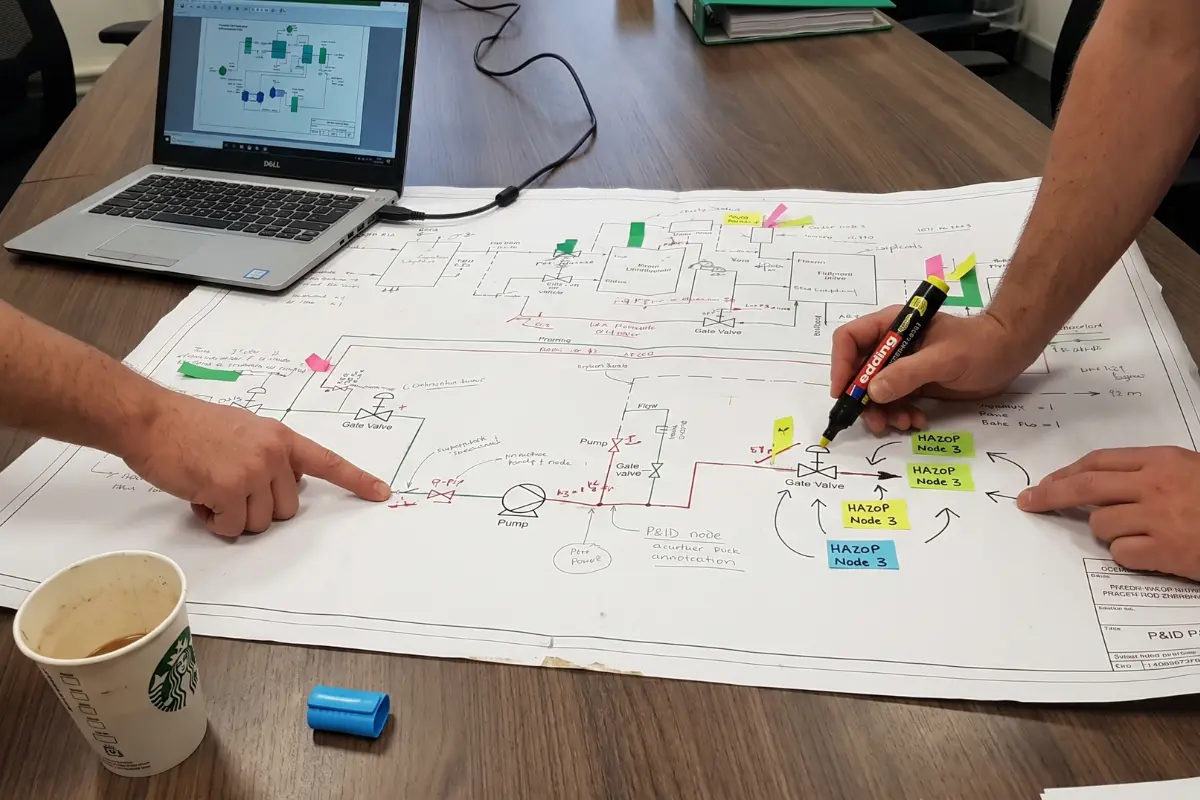
Securing innovation: a GOSP pilot HAZOP
Integrating a new technology unit into a live, operating facility is never straightforward. When two technology partners set out to pilot a Direct Lithium Extraction (DLE) process at a major energy operator’s Gas-Oil Separation Plant in the Arabian Peninsula, they needed one question answered before anything else: is this safe?
That’s where we came in.
The challenge: new tech, live facility
Your pre-treatment and DLE units don’t operate in isolation. They connect directly to an active High Pressure Production Trap (HPPT) — a system already under load, with its own pressure regime and safeguards.
The risk isn’t just in the new equipment. It’s at every point where the new meets the existing. A valve left open in the wrong position. A regulator failure. A relief path that looks clear on paper but isn’t. These are the scenarios that cause incidents on pilot projects, and the reason a rigorous Hazard and Operability (HAZOP) study was the right first step.
Staterra facilitated the HAZOP study, working across two nodes: the pre-treatment facility (including produced water reception, H₂S removal, and water discharge to storage) and the DLE unit (adsorption and desorption circuits). The team brought together representatives from the operator’s operations, maintenance, and Loss Prevention teams, alongside the technology partners, in a single virtual session.
What we found
The study produced 10 recommendations. Here are the critical findings.
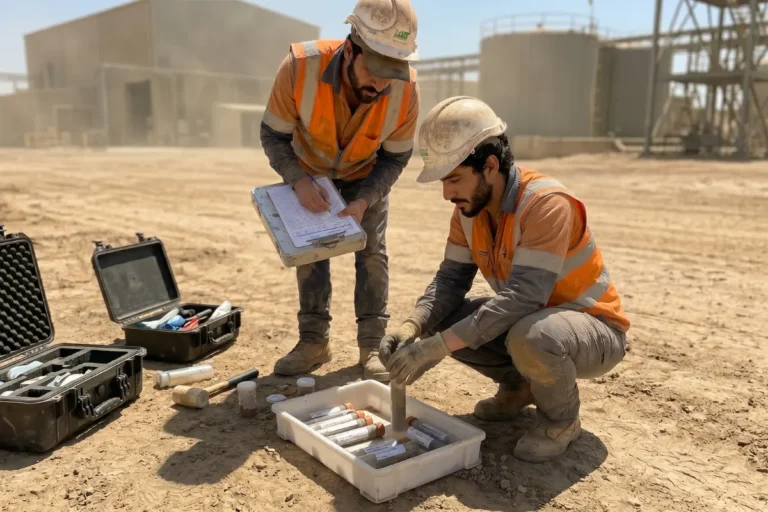
Relief path integrity - PT-01
- The process tank (PT-01) has a design pressure of 90 psi. We found that the discharge piping of its pressure relief valve (PRV) was obstructed by two manual valves and a check valve downstream. In an overpressure event, those components could block the relief path entirely.
Recommendation: replace Valve No.14, Valve No.15, and the check valve with open spools, guaranteeing an unblocked path to the relief system at all times.
Nitrogen regulator failure - up to 2,000 psi
- The N₂ supply line to PT-01 is rated to 1,000 psi. A regulator failure on that inlet could drive pressure in PT-01 up to 2,000 psi – more than twenty times the vessel’s 90 psi design pressure. This is a vessel rupture scenario.
Recommendation: provide enhanced safeguards to address the specific regulator failure modes and prevent loss of primary containment.
H₂S protection - VGS-01 scrubber
- If liquid overfill occurs in PT-01, the sodium hydroxide bath in the vent gas scrubber (VGS-01) is a critical safeguard against H₂S release to the atmosphere.
Recommendation: confirm that both the PRV capacity and the NaOH bath are adequately sized to neutralise H₂S under that overfill scenario, protecting both personnel and the surrounding environment.
H₂S detection at gravity drain
- Manual valves 17A/17B on the oil disposal line to the HPPT gravity drain present an operational risk if left open after use. Gas blowby during filling could introduce H₂S-laden gas to the atmosphere at the funnel connection.
Recommendation: update the P&ID to show the funnel position, and verify – or provide – H₂S detector coverage in that area.
DLE unit - chemical handling and tank integrity
- In the DLE node, we identified risks around the handling of process chemicals managed through standard operating procedures. We also flagged the risk of unattended pump-out from Frac Tank FT-01 drawing sodium hydroxide back into the tank, compromising water quality and DLE performance.
Recommendation: replace the PRV on FT-01 with a breather system.
Fire case - site drainage
- An external pool fire beneath the PT-01 skid could cause overpressure and rupture.
Recommendation: verify that the site is graded to drain away from the skid, preventing hydrocarbon liquid accumulation – and if not, confirm the PRV is sized for the fire case.
The outcome
10 recommendations. One day. Three organisations aligned on a single safety strategy.
That’s what an independent, systematic HAZOP delivers. Not a theoretical risk register – a clear, actionable roadmap that moves a project from identified risk to engineering solution. This pilot is moving forward with a documented, verified safety baseline. It sits alongside projects across the Gulf region as examples of what a systematic, professional approach to process safety delivers – for people, assets, and the future of energy innovation.
For teams running complex pilot integrations in active facilities, that foundation isn’t a nice-to-have. It’s the difference between a successful pilot and an incident report.
Running a pilot integration on an active facility? Talk to us.