

RCER‑2025 in practice: getting RCJY permitting right, first time
If you operate in Jubail, Yanbu, Ras Al Khair or Jazan, RCER-2025 has changed how you plan projects, manage risk and budget for environmental performance.
In our RCER-2025 practical guide, we unpacked the main regulatory changes, including new attention to soil quality, site closure, and permit lifecycle planning.
This article takes the next step: a practical guide to planning and delivering your Royal Commission permitting pathway under RCER-2025, from your first Environmental Screening Questionnaire (ESQ) through to a well-structured Permit Application Package (PAP).
- First decision: NCEC or RCJY?
Many projects lose time at the first fork in the road: are you dealing with the National Center for Environmental Compliance (NCEC), or are you in a Royal Commission city and therefore on the RCJY permitting pathway?
At the national level, NCEC is the main environmental regulator for Saudi Arabia and the starting point for projects outside Royal Commission jurisdictions.
Within Jubail, Yanbu, Ras Al Khair and Jazan industrial cities, environmental permitting is generally handled through the Royal Commission framework, with project location and jurisdiction determining the route.
That distinction matters early, because the wrong pathway can create duplicate work, mismatched submissions, and avoidable delays.

The decision that saves the most time is simple but often skipped:
- Confirm location: inside or outside an RCJY industrial city.
- Confirm regulator: who will ultimately sign your EIA and permit.
Getting this wrong means duplicated effort or submissions going to the wrong authority.
If you are still mapping the broader landscape across MEWA, NCEC and RCJY, our high-level guide to environmental compliance in Saudi Arabia provides a useful overview.
Time-bound obligation under RCER-2025
RCER-2025 has also increased pressure on operators in RCJY industrial cities to review existing permits, EIAs and operating practices against the new framework. For many operators, that gap analysis exercise is the first real test of whether legacy approvals and on-the-ground controls still align with current expectations.
If you want to keep the six-month deadline, verify it directly against the regulation text before publication rather than relying on secondary references.
- RCJY permitting under RCER-2025: the core sequence
For RCJY projects, one document does more to protect – or damage – your schedule than any other: the Environmental Screening Questionnaire (ESQ).
Environmental Screening Questionnaire (ESQ)
The ESQ drives your project’s category (1, 2 or 3).
A conservative or poorly framed ESQ can push a project into a higher category than necessary, adding months of extra study and review.
Project categorisation (Cat 1-3)
- Category 1: negligible or no environmental impact
- Category 2: potentially moderate impact
- Category 3: significant potential for adverse impact
That label dictates the level of assessment and the likely lead time to secure permits.
Scoping and EIA
For Category 2 and 3 projects, RCJY usually expects:
- An Environmental Scoping Report defining what will be assessed.
- An EIA that evaluates impacts and mitigation across air, noise, water, soil, groundwater and waste, reflecting RCER-2025’s tightened expectations.
Permit Application Package (PAP)
Your permit is then based on a PAP made of RCJY application forms plus the technical documents that support them.
Environmental Emergency Response Plan (EERP)
An EERP sets out how you will manage incidents that could affect people or the environment, consistent with the risks identified in the EIA.
The strongest applications treat ESQ, EIA, PAP, EERP and Scoping Report (ESR) as one coherent story, project, risk and control, rather than four disconnected documents.
- When is an EIA really required?
A common client question is: “Do we actually need a full EIA for this?”
Under RCJY:
- Category 1 projects normally do not require a detailed EIA.
- Category 2 and 3 projects typically do require an EIA, but the depth and scope should match the true risk profile.
A well-designed ESQ and Scoping Report can focus the study, providing enough evidence to satisfy RCJY, without commissioning studies that add cost and time but little regulatory value.
In practice, the most efficient EIAs under RCER focus tightly on material risks such as air emissions, odour, noise, soil and groundwater, while avoiding generic “boilerplate” analysis that does not influence RCJY’s decision.
- The PAP and its 24 forms: the real bottleneck
The real bottleneck is rarely the EIA.
It is the multi-form Permit Application Package (PAP), which is specific to RCJY.
Under RCER-2025, the PAP structure still consists of a total of 24 forms, but only those relevant to the specific project need to be submitted.
RCJY’s PAP covers different industrial activities and environmental aspects.
Most delays come from two patterns:
- Over-declaration: ticking too many forms, creating unnecessary work and extra questions from reviewers. Precision here is often the difference between a four-week and a four-month approval cycle.
- Under-declaration: missing forms that should be included, triggering clarification requests and re-submissions that push back permits.
A strategic approach at this stage typically focuses on:
- Mapping the project against RCER-2025 and RCJY expectations to identify which forms are genuinely applicable.
- Aligning EIA content with PAP information needs so you are not duplicating effort or leaving gaps.
- Reviewing the PAP as a regulator would: is there a clear line of sight from project description to risk assessment, controls and EERP commitments?
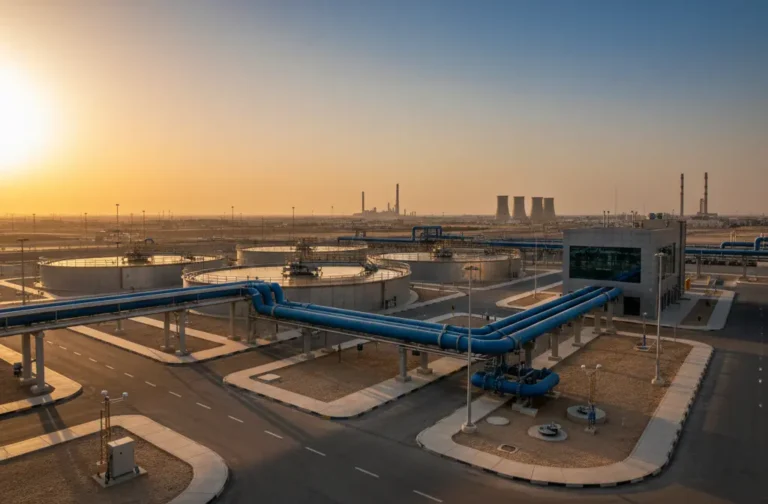
In our Jubail Advanced Treatment Unit case study, the PAP was built only around forms relevant to wastewater treatment, hazardous sludge, air emissions and noise, all backed by targeted modelling and baseline data.
That precision helped the client secure the Environmental Permit to Construct without iterative rounds of questions.
- Treat permitting as a condition for FID, not paperwork
Under RCER-2025, environmental permitting is no longer an administrative afterthought.
For many projects, credible compliance with RCJY and NCEC expectations is now a prerequisite for Financial Investment Decision (FID) and lender confidence.
A well-run permitting strategy means:
- Engaging early to map your project against RCER-2025 and RCJY expectations before design choices lock in unnecessary risk and cost.
- Designing your permitting pathway alongside FEED, FID and lender requirements, so EIA, PAP and EERP support – not delay – financial close.
- Drawing on experience from multiple RCJY and NCEC engagements to anticipate the issues regulators are most likely to challenge, and addressing them proactively.
If your team is preparing an ESQ, EIA or PAP for a project in Jubail, Yanbu, Ras Al Khair or Jazan and wants to avoid surprises at RCER-2025 review, get in touch – our team can review your current permitting strategy and highlight the decisions that will have the biggest impact on timeline and FID readiness.
This article was written by Remya Rajagopal – Associate Consultant, Environmental Services