
When pipelines age, the environment pays attention
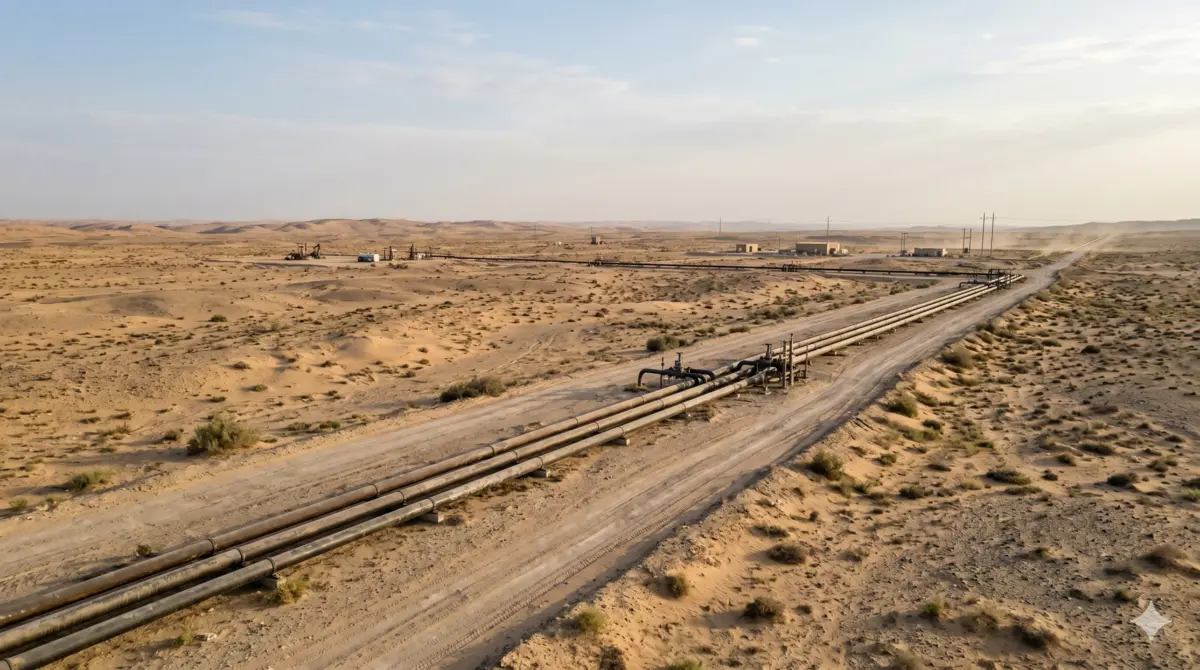
Saudi Arabia’s upstream oilfields are dynamic systems. As water cut rates rise and operating velocities drop, pipelines designed for different conditions decades ago begin to corrode from the inside – quietly, persistently, and at scale. The mechanical integrity risk is real. So is the environmental liability that accumulates alongside it.
Replacing aged infrastructure isn’t just an engineering decision. It triggers one of the most complex environmental permitting sequences in the Kingdom, and how that sequence is managed determines whether your project stays on schedule or doesn’t.
Not one project. Twelve regulatory conversations.
A pipeline replacement programme of this scale – 44 onshore lines spanning crude oil, water injection, and produced water service across multiple northern area fields – doesn’t present a single environmental picture. It presents twelve.
Those 44 lines are grouped into 12 distinct Environmental Classification Form (ECF) clusters, each assessed and submitted to NCEC independently. The classifications range from Category 1 through to Category 3, and the regulatory obligations differ substantially between them:
- Category 1 clusters require an Environmental Management Plan (EMP) – a defined but comparatively streamlined deliverable
- Category 2 clusters require a full Environmental Impact Assessment with baseline surveys
- Category 3 clusters require an Environmental Scoping Report submitted to and approved by NCEC before baseline fieldwork begins, followed by a comprehensive EIA covering air quality modelling, noise, soil, groundwater, waste minimisation, and water management
Managing these tiers in parallel, with different submission timelines, different regulatory review windows, and different data requirements, is where environmental programmes on projects like this either hold the schedule together or fragment it.
Navigating multi-layered approvals
The regulatory framework here operates at three levels simultaneously, and all three must be satisfied.
At the national level, NCEC is the primary authority, issuing the Environmental Permit to Construct (EPC) that must be in place before construction begins. Every EIA study, every EMP, every scoping report flows through NCEC review and approval.
At the company level, Saudi Aramco’s own engineering procedures govern how the assessment is conducted. SAEP-13 defines the EIA methodology. CP-23 and CP-25 – the active Environmental Protection and Water Conservation Policy Statements – set the strategic commitments that the project must demonstrate it upholds. A long list of supporting standards, from SAES-A-104 on wastewater treatment to SAES-A-105 on noise control, form the technical baseline against which mitigation measures are evaluated.
At the construction activity level, a separate Construction Environmental Management Plan (CEMP) – including a dust mitigation programme per SAEP-102 – must be submitted to EPD/EED/AMU for review and approval before any ground is broken.
Navigating all three simultaneously, without conflating their requirements or letting one delay another, requires a clear programme architecture from day one.
Two phases of work. No shortcuts.
Phase 1 - Baseline & Scoping
Before any impact can be assessed, you need to know what you’re starting with. For the higher-category clusters on a project like this, that means:
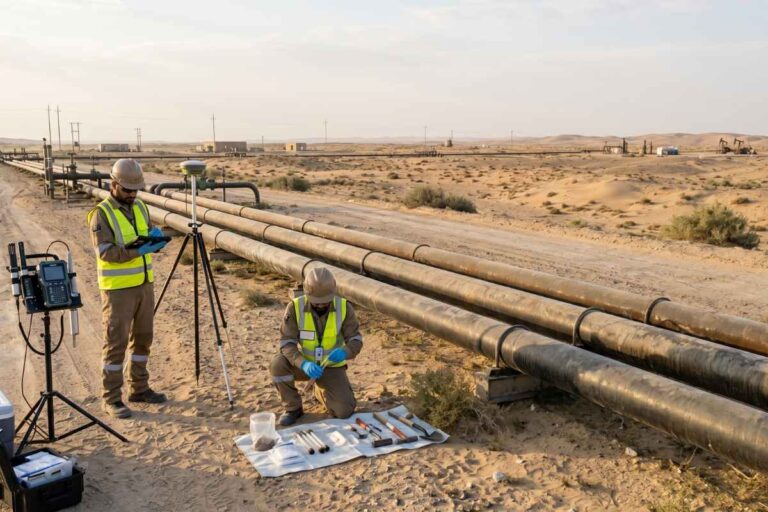
- Continuous ambient air quality monitoring deployed at representative locations, GPS-logged, with sensitive receptor mapping
- Class 1 sound level meter surveys establishing existing noise baselines at facility boundaries
- Surface soil sampling sent to NCEC-accredited laboratories, analysed against a defined contaminant list including TPH, BTEX, heavy metals, and PAHs
- Groundwater baseline establishment, with flow direction modelling to assess contamination risk pathways
- A Water Optimisation Study addressing wastewater generated from scraping activities – treatment options, disposal routes, and reuse potential evaluated against CP-25 and SAEP-327
For Category 3 pipelines, the Environmental Scoping Report documenting this baseline methodology must be approved by NCEC before the full EIA work begins. That sequencing has to be built into the programme, not discovered mid-delivery.
Phase 2 - Assessment, Mitigation & Deliverables
A structured 30-workday development window from baseline validation to draft EIA submission ensures data robustness over guesswork. The deliverables package for the higher-category clusters includes:
- Full EIA study addressing impacts across construction, commissioning, and operations – with mitigation measures specific to each identified impact, not generic reassurances of standards compliance
- Air dispersion modelling using US EPA-approved AERMOD methodology
- Noise propagation modelling with quantified fence-line predictions and mitigation specification where thresholds are approached
- A Waste Minimisation Assessment identifying every anticipated waste stream by type, estimated quantity, and compliant disposal pathway, including old pipe abandonment, legacy insulation management under GI-0150.001, and pipeline scraper wastes
- A Health Impact Assessment covering construction, operational, and emergency scenarios, aligned with IFC World Bank and IPIECA guidance
- An Environmental Management and Monitoring Plan (EMMP) – the operational framework that keeps the facility compliant through its full working life, not just through permitting
Once NCEC approves the EIA, the final document must stand alone – complete, self-contained, and ready for ministerial review without supplementary reference to the project design package. That submission-ready quality has to be designed in from the start, not edited in at the end.
Beyond the permit: eliminating the liability
Replacing corroded infrastructure eliminates an active environmental liability. Pipelines experiencing internal corrosion are a direct threat to soil integrity, groundwater, and surrounding ecosystems – risks that compound with every year of deferred action.
On projects of this scale, environmental permitting extends far beyond a simple impact assessment. Major capital projects in the Kingdom must demonstrate a comprehensive strategy for water management across the full lifecycle, from initial hydrotesting and pipeline flushing to long-term operational phases. Saudi Aramco’s Water Conservation Policy (CP-25) defines this mandate: ensuring efficient utilisation, responsible disposal, and the active pursuit of alternatives to groundwater. For a 44-line replacement programme, satisfying these regulatory expectations requires a robust, technically-sound framework that is practically implementable—it is a substantive engineering commitment, not an administrative checkbox.

Projects like this are also a visible marker of Vision 2030‘s industrial sustainability commitments in practice: replacing ageing, non-monitored infrastructure with modern, corrosion-controlled systems that include chemical injection, internal inspection programmes, and scraping facilities designed for the water cut realities of today’s operations.
The environmental permitting process on a multi-field, multi-category pipeline programme is not a linear task. It’s a parallel-track, regulation-layered programme management challenge – one where the quality of the environmental work directly affects the speed of the engineering work.
If you’re at the early stages of a pipeline upgrade, replacement, or brownfield expansion in Saudi Arabia, the time to structure your environmental programme is before your engineering design is locked, not after.
Get in touch with our team to discuss your project scope.