
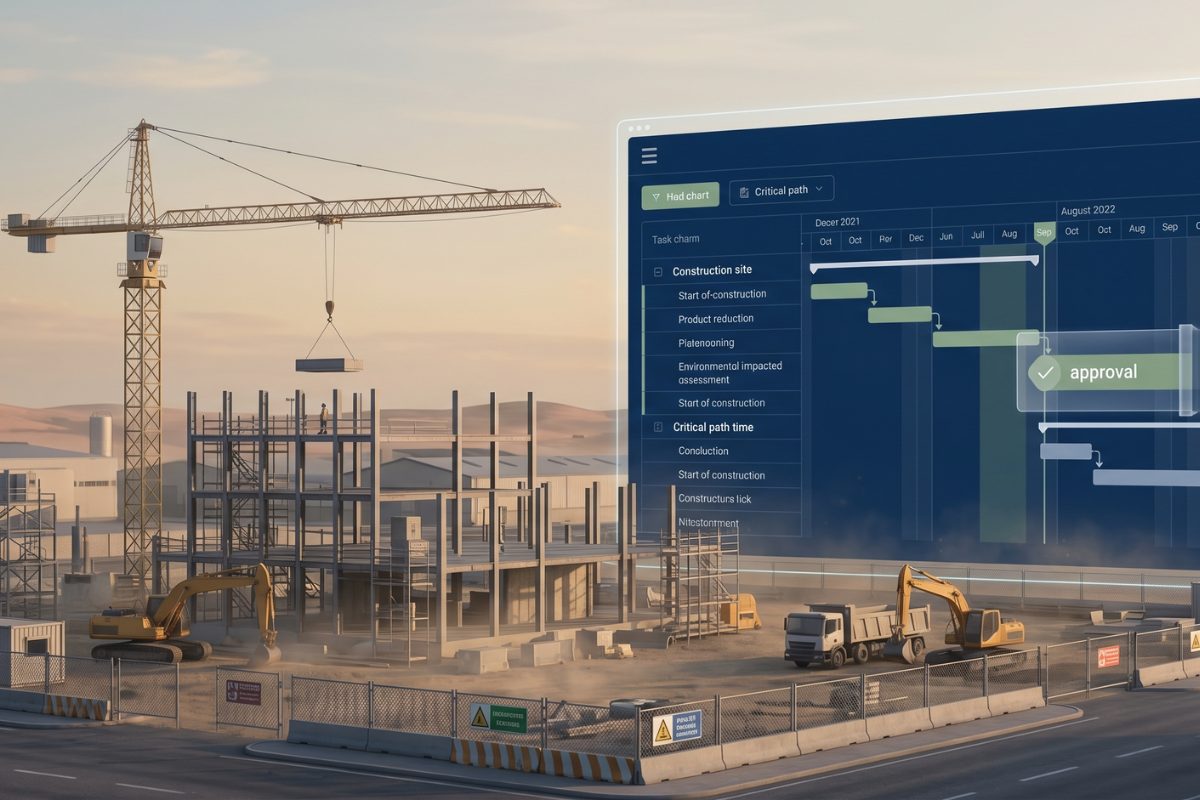
Your EIA is on the critical path. Don’t let it become the bottleneck.
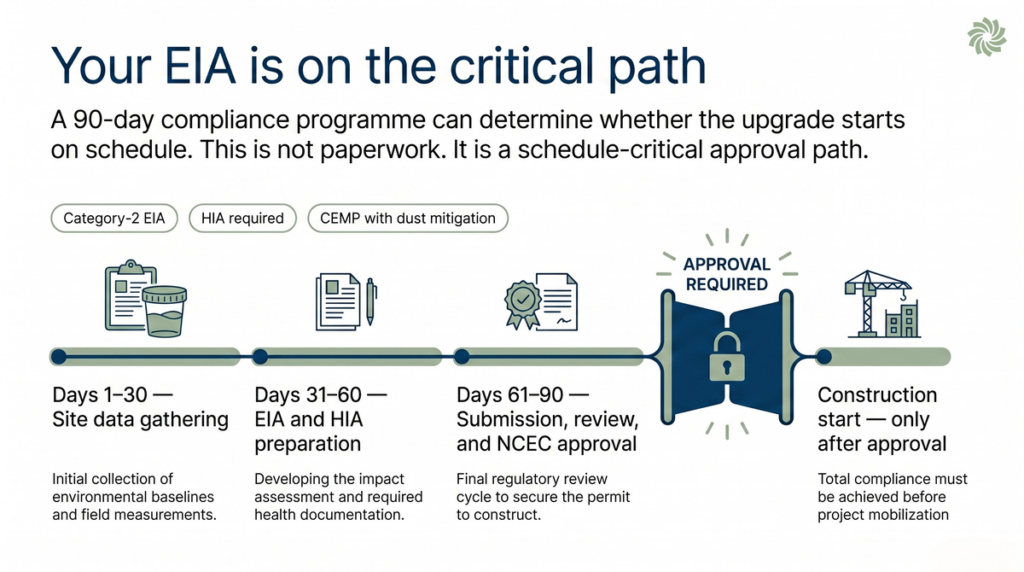
Four facilities. Ninety days. A Category-2 EIA that has to satisfy NCEC, align with SAEP-13, include a Health Impact Assessment, and land a Construction Environmental Management Plan with a dust mitigation component, all before a single upgrade to Dhahran, Qatif, or Al Hasa’s fire and oily water systems can begin.
That’s not a paperwork exercise. That’s a compliance programme with real consequences for your construction schedule.
The scope is more demanding than it looks
On paper, an infrastructure upgrade to fire detection, foam, firewater, and oily water drainage systems sounds straightforward. In practice, the environmental pathway is anything but.
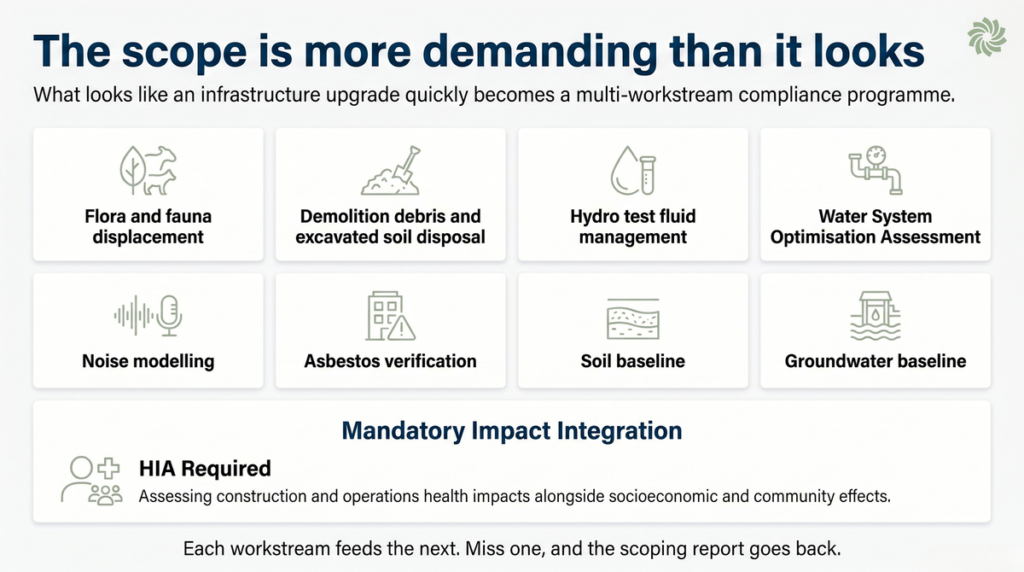
The EIA alone must cover flora and fauna displacement, demolition debris and excavated soil disposal, hydro test fluid management, a mandatory Water System Optimisation Assessment, occupational and equipment-generated noise modelling, asbestos verification across all new and replaced materials, and a full soil and groundwater baseline. Each workstream feeds into the next. Miss one, and your scoping report goes back.
Then there’s the HIA. Not a standard deliverable on most projects – and not one where a generic template will satisfy the Authority. It needs to assess positive and negative health impacts across both construction and operations, cover socioeconomic effects on the surrounding population, and identify specific management actions for anything unintended.
Ninety days covers all of it. Thirty for site data gathering. Sixty to prepare, submit, and secure NCEC approval.
What this kind of timeline actually requires
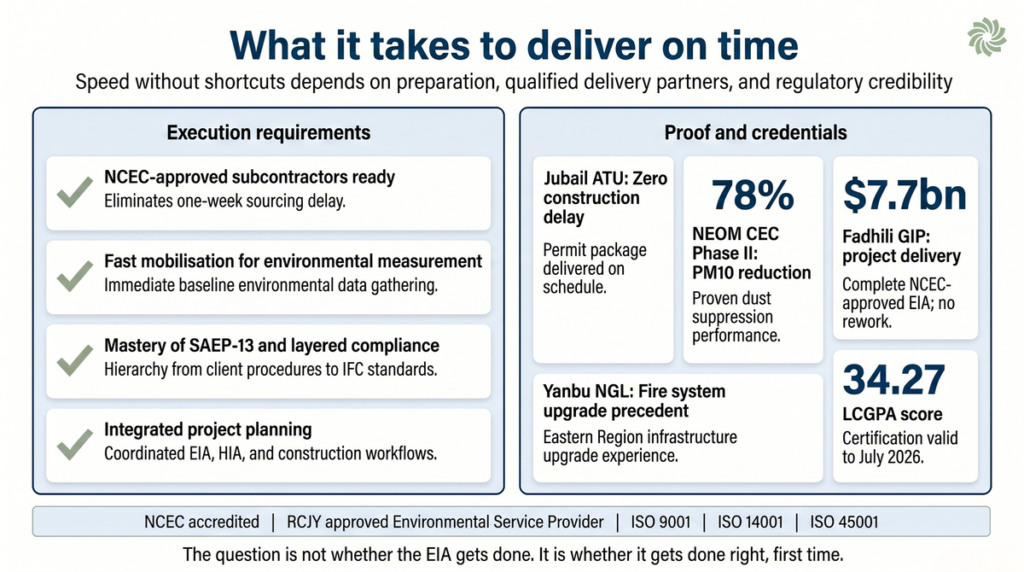
Speed without shortcuts means having the right sub-contractors already qualified. Every site measurement – air quality, noise, soil, groundwater – must be executed by NCEC-approved parties. If you’re sourcing those relationships at contract award, you’ve already lost a week.
It also means knowing the regulatory framework before you open the scoping document. SAEP-13 sits within a seven-level compliance hierarchy, from client engineering procedures and NCEC/RCER regulations through to World Bank IFC Performance Standards, Equator Principles, and ISO 9001/14001/45001. An EIA that satisfies one layer but not another creates friction downstream.
At the Jubail Advanced Treatment Unit expansion, we faced a comparable challenge: complex waste streams, noise impacts, groundwater sensitivity, and a client who could not afford regulatory delays. We delivered a complete Permit Application Package – waste management plan, noise propagation study, groundwater risk assessment, EERP, and EMMP – and secured the Environmental Permit to Construct with zero delays to the construction timeline.
Proof before credentials
Speed We could list our accreditations first. But the more useful question is: what does that look like on an active project?
At the NEOM Circular Economy Centre Phase II, our dust suppression programme cut PM10 emissions by 78% during construction. Our HIA and community engagement work – over a dozen direct stakeholder meetings – resulted in 90% of surveyed community members reporting increased project confidence. At the Fadhili GIP Fixed Facility Expansion, a $7.7 billion project, we delivered the full NCEC-approved EIA suite: CEMP, CWMP, ESAICR, ENVID, AERMOD air dispersion modelling, and MODFLOW groundwater analysis. Permit secured. No rework.
For fire system upgrades specifically, the Yanbu NGL Fractionation Plant is the closest precedent, a project where our EIA scope covered the same infrastructure typology you’re dealing with in the Eastern Region.
Then the credentials, for those who need them
Staterra holds full NCEC accreditation to conduct EIAs, RCJY authorisation as an approved Environmental Service Provider, and a verified LCGPA Local Content Certification score of 34.27, audited and valid to July 2026. ISO 9001, ISO 14001, ISO 45001 certified.
These aren’t credentials we lead with. They’re the foundation that lets us move quickly when your timeline demands it.
The question isn’t whether the EIA gets done. It’s whether it gets done right, first time.
If you’re working on infrastructure upgrades in the Eastern Region, or anywhere in KSA, talk to us before the clock starts.