

Why the GCC’s climate risk and ESG disclosure market isn’t waiting for the mandate
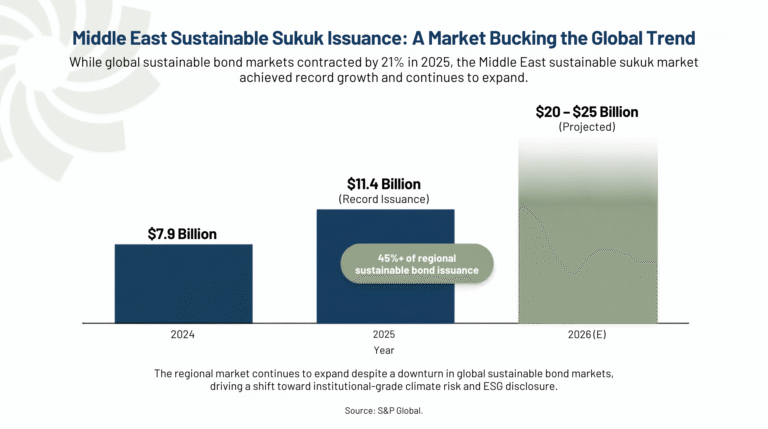
While global sustainable bond markets contracted by 21% in 2025, the Middle East grew. Sustainable sukuk issuance in the region hit a record $11.4 billion last year, up from $7.9 billion in 2024, and now accounts for more than 45% of regional sustainable bond issuance by value. As reported by Arab News, S&P Global expects total sustainable bond issuance across the Middle East to reach $20-25 billion in 2026.
That growth brings scrutiny with it. As sustainable debt issuance scales, investors and rating agencies are getting sharper at distinguishing a credible climate disclosure from a decorative one – and for corporates and financial institutions across the GCC, the practical question is no longer whether climate risk and ESG disclosure will matter to access to capital. It’s whether your reporting would hold up to that closer look today.
None of this requires a company to already have a climate strategy in place. It requires knowing, concretely, where you currently stand – because the gap between “no framework” and “investor-grade disclosure” is exactly the gap the next two years are going to close, one way or another.
A patchwork mandate, a single expectation
Formal adoption of the ISSB’s IFRS S1 and S2 standards – the emerging global baseline for sustainability and climate-related financial disclosure – is moving at very different speeds across the Gulf.
- UAE – moved fastest. The Securities and Commodities Authority’s mandatory ESG disclosure requirement for listed companies is already in force, with IFRS S1/S2 alignment required from FY2026. The Federal Climate Change Law makes Scope 1 and 2 emissions reporting binding by 30 May 2026, and the Central Bank of the UAE holds financial institutions to their own deadline in September 2026.
- Qatar – IFRS S1/S2 reporting is mandatory for QCB-regulated banks and insurers from 1 January 2026, with the QFC Regulatory Authority applying the same standard to large regulated firms. First reports are due mid-2027.
- Kuwait – the Capital Markets Authority requires Premier Market-listed companies to publish ISSB-aligned ESG reports covering 30 KPIs from FY2025, due 30 June 2026.
- Bahrain – mandatory ESG reporting for listed corporations and financial institutions since 2024.
- Saudi Arabia – a different path. General ESG disclosure remains voluntary, mandatory only for green, social, and sustainability-linked debt issuers, while SOCPA continues its review of IFRS S1/S2. But voluntary adoption is already running ahead of that review: 94 Tadawul-listed companies published sustainability reports in 2024, up from 81 in 2023, and roughly 65% of the Kingdom’s 100 largest listed companies by revenue now disclose ESG information without being required to.
That’s the Kingdom’s own investor base setting the bar – the companies worth watching aren’t the ones waiting for a mandate, they’re the ones already reporting to a standard the market recognises. (We looked at Saudi Arabia’s own shift from voluntary guidance to disclosure expectations in more detail in an earlier piece; here, the lens is wider – the whole Gulf, and what changes once ESG disclosure becomes a financing question as much as a compliance one.)
TCFD didn’t disappear. It became the law.
The Task Force on Climate-related Financial Disclosures formally disbanded in October 2023, its four pillars – governance, strategy, risk management, and metrics and targets – absorbed wholesale into IFRS S2. 2026 is broadly regarded as the year the transition period closes: what used to be a voluntary best-practice framework is now, in an expanding list of jurisdictions, a line item in the audited financial statements.
That distinction is the one many Gulf companies still underestimate. TCFD-style reporting used to sit with the sustainability team. Under IFRS S2, climate risk sits with finance too, because it’s now expected to be quantified with the same rigour as any other item that could affect cash flow, access to finance, or cost of capital.
Physical risk isn’t abstract here
The physical climate risks that make Gulf cities vulnerable also make Gulf corporate assets vulnerable. Extreme heat, water stress, and flood exposure – the same pressures we set out in our recent look at heat resilience in the Gulf – are precisely the categories IFRS S2 and the TCFD framework it absorbed require companies to model and disclose, typically against RCP 2.6/4.5/8.5 emissions scenarios at the asset level.
A portfolio-level physical risk assessment isn’t a nice-to-have anymore; for an asset owner or lender, it’s the difference between a disclosure that satisfies an auditor and one that satisfies an international lender’s independent technical review.
That same rigour applies below the climate-model layer too. Legacy site contamination, groundwater condition, and land-use history are GRI-reportable (GRI 303, 304, 305) and increasingly part of a lender’s environmental risk view. The quality of a company’s own remediation and monitoring data – the unglamorous work behind restoring contaminated soil and groundwater to a safe standard – ends up mattering as much to disclosure credibility as any climate scenario model.
Transition risk is the other half of the equation, and it moves on a different clock. As carbon pricing tightens and the low-carbon policy environment shifts globally – modelled against IEA scenarios from Stated Policies through Net Zero 2050 – Gulf companies with high-emissions operations face a genuine question of stranded asset exposure that needs to be quantified, not asserted.
Capital markets are already pricing this in
The sukuk and green bond numbers above are the mechanism through which disclosure quality becomes a cost-of-capital question. ICMA’s Green Bond Principles and Sustainability-Linked Bond Principles set the transparency bar issuers are now measured against, and greenwashing scrutiny is rising in step with issuance volume: a green bond or sukuk framework built on soft, unverifiable claims is a reputational and legal liability in a market where investors increasingly know what a credible framework looks like.
Two audiences, two starting points
For corporates, the priority is a gap analysis against IFRS S1/S2 now, not at the point a lender or exchange makes it mandatory – because building genuine asset-level physical and transition risk data takes longer than most disclosure timelines allow for.
For banks, insurers, and asset managers, the calculus is different but related: climate risk is now a lending and underwriting input as much as a disclosure obligation, and portfolio-level exposure – to sectors, geographies, and counterparties – needs the same asset-level rigour as the corporates they finance.

How Staterra helps
Since establishing our dedicated Climate Change & Sustainability practice, this is the work we do – for corporates and financial institutions alike:
- TCFD-aligned climate risk assessments
- ISSB/IFRS S1 and S2 gap analysis and disclosure readiness roadmaps
- Asset-level physical risk modelling
- Transition risk and stranded-asset assessment
- Green bond and sustainability-linked framework development
That work sits alongside, not in place of, the assurance process auditors and assurance providers apply to the final disclosure – getting the underlying data and modelling right is what makes that process faster and less adversarial. We’re not in the business of helping clients tick a box. We’re the bridge between the climate science and the investor-ready reporting that sits on top of it.
Climate disclosure is no longer optional for Gulf companies accessing international capital – it is the price of entry. The window to get ahead of a mandatory requirement, rather than scramble to meet one after the fact, is still open across most of the region. It won’t stay that way for long.
Get in touch to talk about where your organisation’s climate risk and ESG disclosure readiness currently stands.
Author: Hussien Al Kisswani – Lead Consultant, Climate Change & Sustainability, Staterra