

Why oil and gas projects face a heavier environmental permitting load
Many oil and gas developments in Saudi Arabia fall within higher-impact environmental classifications, depending on their scale, activity and location. That classification, more than any single technical challenge, is what sets the sector apart from other industrial development. It triggers a wider net of assessments, extends timelines, and demands technical depth that many projects in other sectors never have to plan for.
A classification that shapes everything downstream
Once a project falls into this category, environmental approval is rarely a single-document exercise. Depending on scope, location, and regulatory classification, a single project may require multiple Environmental Impact Assessments running in parallel, alongside a set of supporting studies that most non-oil-and-gas developments will never need:
- Best Available Techniques (BAT) analysis (RCJY/RCER-specific)
- Sustainability assessments
- Waste minimisation studies
- Water optimisation evaluations
- Greenhouse gas (GHG) assessments
- Circular economy considerations
Depending on the applicable regulatory framework and project scope, these may form part of the required permitting package rather than optional supplementary studies. They’re frequently prerequisites for approval, and each carries its own technical input, timeline, and sign-off. For projects permitted through the Royal Commission for Jubail and Yanbu (RCJY), RCER-2025 in practice sets out how that permitting process works. Our view: the real planning risk isn’t the process itself, it’s treating the additional studies as scope creep to be discovered mid-project rather than requirements to be scoped from day one. Early identification of which studies apply is what keeps a project on schedule rather than discovering a missing assessment midway through construction. Our environmental assessment and management service is built around exactly this: scoping the full set of required studies before they become critical-path surprises.
The operational picture doesn’t stop at approval
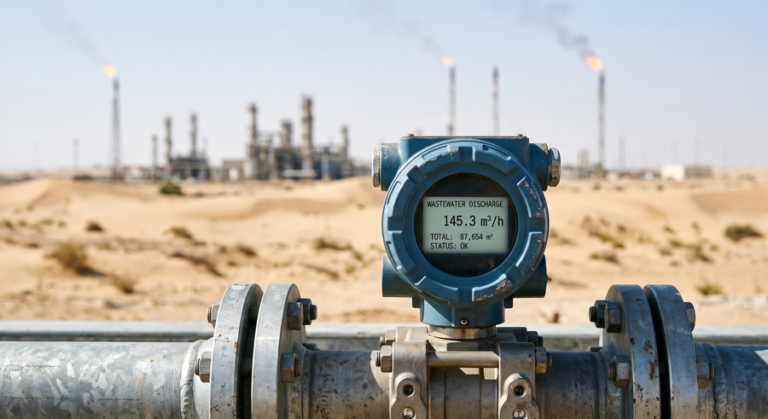
Getting permitted is the start, not the end. Once operational, oil and gas facilities carry ongoing environmental obligations across air emissions, greenhouse gas reduction, wastewater handling, hazardous waste management, and biodiversity protection, alongside growing ESG reporting expectations from regulators, lenders, and investors. NCEC monitors compliance with these obligations throughout a facility’s operating life, not just at the permitting stage.
International frameworks add a further layer. Projects seeking IFC or World Bank-linked financing are expected to align with the Environmental, Health and Safety Guidelines for Oil, Gas, and Mining alongside local NCEC and RCJY requirements. Reconciling the two frameworks early avoids surprises for projects with mixed local and international financing.
Sustainability is becoming a strategic priority in the oil and gas sector, not a compliance afterthought. Treating environmental planning as a permitting-stage problem leaves the operational obligations to catch companies by surprise later.
Staterra’s experience in the sector
Staterra has supported more than 90 environmental projects in the oil and gas sector in Saudi Arabia, spanning environmental impact assessment, monitoring and compliance audits, sustainability strategy, waste and water management planning, marine environmental assessment, remediation, and air dispersion modelling using tools such as AERMOD, GIS mapping, and ISO 14001-aligned management systems.
Proactive environmental management reduces long-term operational and compliance risk. For projects entering the significant-impact classification, that means treating the full scope of required studies, not just the headline EIA, as part of the critical path from day one.
If your project is approaching this classification threshold, we can walk you through what applies before it becomes a scheduling problem. Not sure which of these studies apply to your project? Get in touch and we’ll help you scope it properly.
Author: Remya Rajagopal, Associate Consultant, Environmental Services, Staterra